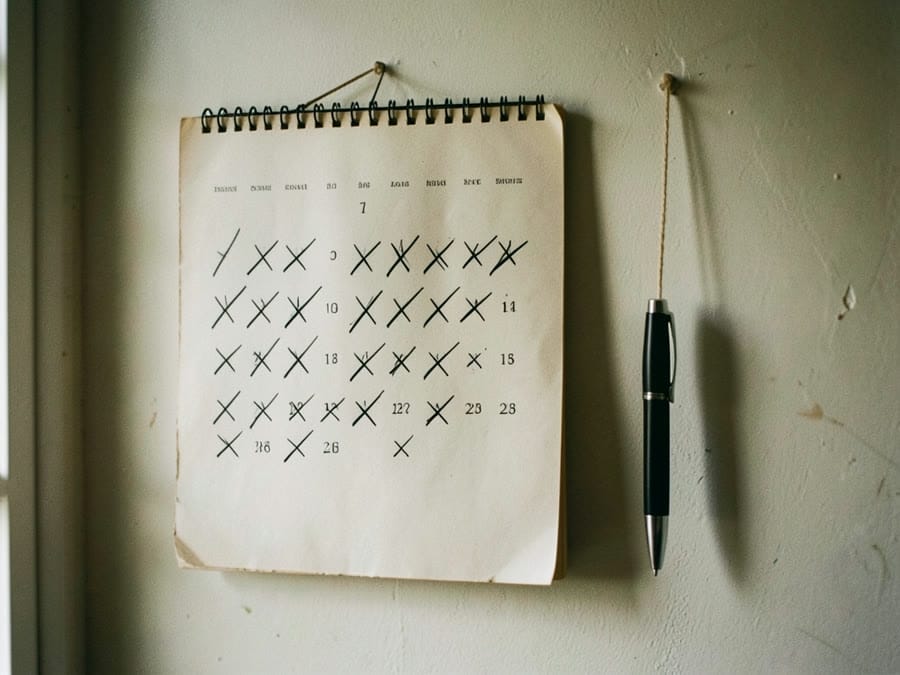
The 30-second read
| 1 | Your old challenges died because they were moods, not tests. Run an experiment instead. |
| 2 | One action, a minimum dose, a one-line daily log, and a verdict on day 30. |
| 3 | Today: write your hypothesis and minimum dose on paper and book the day-30 review. |
Why every new start died by week two
The ninety-day transformation. The 5 a.m. routine that lasted until the second Tuesday. Each one had no single action, no end date and no way to tell if it was working. Get in shape. Fix my money. Those aren't plans. They're moods, and moods fade right around week two.
A challenge is pass/fail on willpower. Miss once, it feels broken, you quit, and the quitting becomes more evidence against yourself. The flaw was never your character. It was the design. An experiment produces data, and data is useful whether the answer is yes or no.
| Ten pages a day, carried forward | |
| 30 days, the experiment | 300 |
| 66 days, the average time to automatic | 660 |
| 365 days, a full shelf | 3,650 |
| Pages read. The first two weeks feel quiet. Quiet is normal, and it's exactly where most people quit. | |
How thirty days rewired Matt Cutts
In his 2011 TED talk, Matt Cutts described running this over and over. A photo every day for a month. A month without sugar. A 50,000-word novel in thirty days, about 1,667 words a day. Each had a fixed window and a clear daily action, so each ended with an answer.
As the experiments stacked up, his confidence grew, and it carried him to biking to work and eventually up Mount Kilimanjaro. His own lesson: small, sustainable changes were the ones most likely to stick.
The protocol: four rules
| 1 | Change one variable Pick a single daily action the person you're becoming would plainly do, and write it as "If I do this daily for 30 days, I'll be someone who ___." |
| 2 | Set a minimum dose Two pages, five minutes, one set: on a rough day you do the minimum and the day stays in the data. |
| 3 | Log one line a night, on paper Across 138 randomized studies, prompting people to monitor progress improved goal attainment, more so when it was physically recorded (Harkin et al., 2016, mostly health goals). |
| 4 | Book the day-30 review before you start Read the log and choose keep, adjust or drop, and all three count as wins because they're decisions made from evidence. |
| 66 | days, on average, for a new daily behavior to become automatic. Missing a single day did not materially affect the process. Lally et al., 2010. 82 people, simple eating, drinking or activity habits; range 18-254 days, upper end projected. |
Stop auditioning for a new life and start testing one.
Your move today
| Write your one-line hypothesis and your minimum dose on paper. | |
| Start the daily log on Monday, 9 November. | |
| Put the day-30 review on the calendar now: Wednesday, 9 December. |
The next thirty days pass either way. Success is not luck. It's a decision made in advance, tested on purpose, and repeated until it becomes who you are.
Stay premeditated.
Sources · Hardy, The Compound Effect (2010). Lally et al. (2010), European Journal of Social Psychology 40(6). Harkin et al. (2016), Psychological Bulletin 142(2). Cutts, Try Something New for 30 Days, TED2011.
All Access: the full deep dive continues below: the habit research in detail, Hardy's magic penny, and why day 30 is a proof of concept, not the finish line.